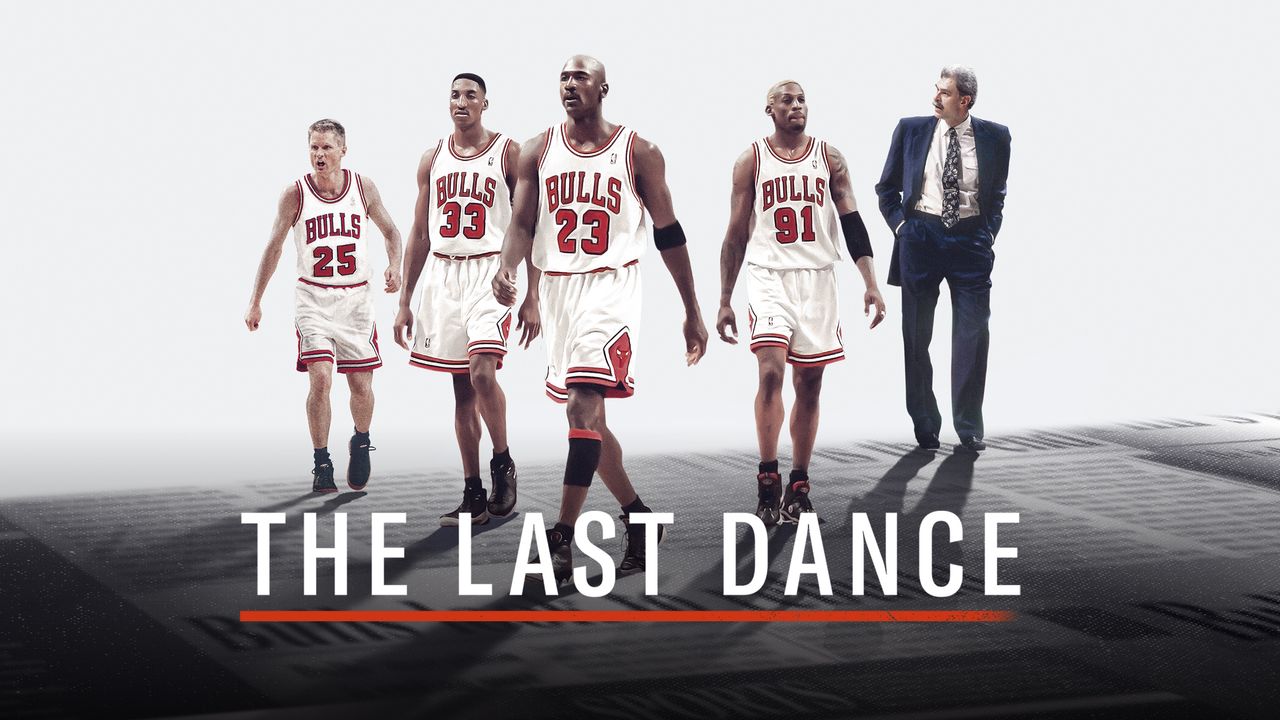
The final two episodes of the well-received look behind the curtain at one of the most storied periods in all of professional sports is a rollercoaster of emotions, taking the audience through incredible triumph, tragedy, loss and leaving the viewer with a painstaking what if? What if the Chicago Bulls dynasty didn’t end in 1998?
#1. That black cat
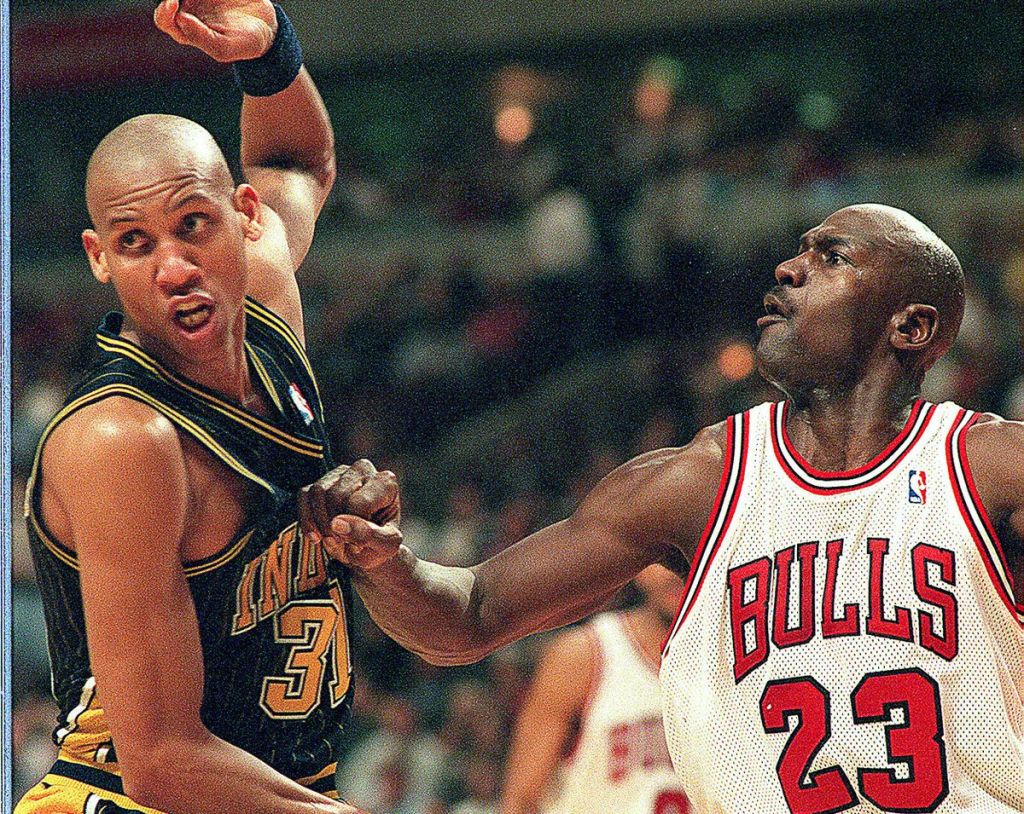
Episode nine opens with Reggie Miller speaking about the intense rivalry that he had with Michael Jordan, with footage being shown of the infamous game in 1993 where the two men got into a physical altercation on the court.
For anyone wondering if Michael Jordan’s intensity has died down since his retirement, when he was shown the footage back, he said while watching, ‘Don’t hold him back. Let him go!’ Reggie delivers a piece to camera attributing their rivalry to the fact that in Reggie’s opinion he didn’t fear Jordan like he felt the rest of the league did. Despite their history, Miller said that, ‘I respected him so much, but he probably thought I was some mouthy, skinny kid.’
Miller regards Jordan as one of the best trash talkers in the sport and tells a story as an example, ‘My rookie year, we’re playing against Chicago. And as a rookie, you’re gonna go 110% because you’re trying to impress your vets on your team. I remember I had, like, 10 points at half, and MJ didn’t shoot the ball particularly great. So, I was like, yeah, you’re Michael Jordan, the guy that walks on water? He looks at me. Second half, I ended up with only two points. So, I had 12 for the game, and he ended up… with a lot more. And I remember him walking off the court. He was like, don’t ever talk trash to Black Jesus.’
Miller concludes the story by saying that after that interaction, he never again referred to MJ as Michael Jordan, he only called him Jordan, Black Jesus or that Black Cat.
#2. Scratching their way to the Finals
The next obstacle for the Bulls’ playoff run in 1998 was the Reggie Miller-led Indiana Pacers in the Eastern Conference finals, much is made on the documentary about the depth and versatility of that Indiana team, a team that also boasted Larry Bird as their head coach, someone that Jordan also had history with. Jordan summed up the difficulty of that series by saying that Indiana gave them the hardest time in the East outside of Detroit throughout the Bulls dynasty and said of the team’s physicality, ‘Every time I’d go in that fucking game and come out, I got a new scratch. It became personal with me.’
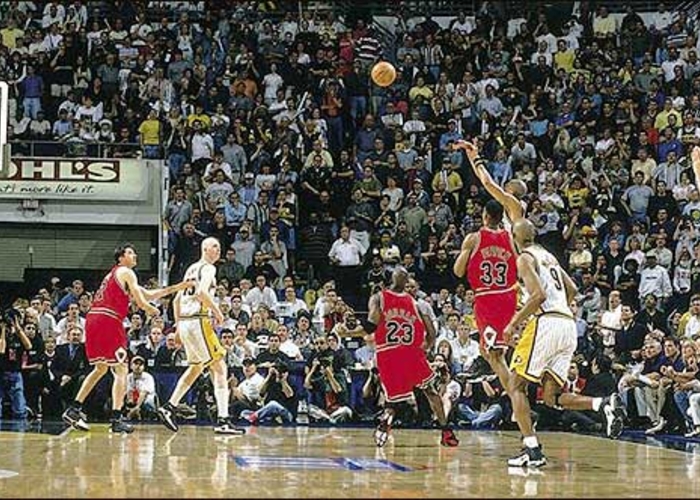
Chicago would win both games on their home court to kick off the series with a 2-0 lead, but the Pacers would fight back and match the Bulls’ effort when the series shifted back to Indiana, including a dramatic finish to game four, where Scottie Pippen missed two crucial free throws and Miller would make a dramatic buzzer beater to tie the series at two-apiece.
After the focus shifts elsewhere, the documentary brings the attention back to the series with the Pacers towards the end of episode nine, where the series is tied at 3-3 after the Bulls and Pacers traded wins in games five and six, leading to only the second game seven that the Bulls would play in their historic run in the 90s.
In that game seven, to many, Indiana looked poised to eliminate the Bulls, until a crucial jump ball with under seven minutes to go in the fourth quarter, the Bulls would win the jump ball and the ball would go to Steve Kerr, who would make a game-tying three-pointer to tie the game at 77. From that point, former Pacers forward Jalen Rose said that, ‘It was like we were a ninth-grade JV team that had no shot.’
The Bulls would win that game seven against the Pacers to set up an NBA Finals rematch against the team that they beat the previous year, the Utah Jazz.
#3. Don’t talk trash to Black Jesus
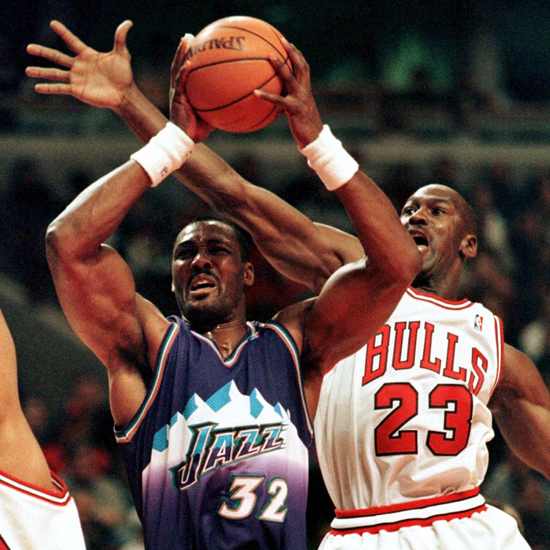
The documentary flashes back to the aforementioned 1997 Finals series against the Jazz, where MJ recalls an interaction with a player that would play on both of the Jazz teams that Chicago would meet in the Finals, Bryon Russell. Jordan says that, ‘When I was playing baseball, Utah’s in town to play the Bulls. They’re practicing at the facility. I go over to say hello to John (Stockton) and Karl (Malone). And this kid, Bryon Russell, comes up to me, says, man, why you quit? Man, you knew I could guard your ass. You had to quit. I said, Karl, you need to talk to this dude, man. But from that point on, he’s been on my list.
Jordan also said that the biggest motivation going into that series with the Jazz was Karl Malone being voted the MVP of the 1996-97 season over him.
Jordan would make a buzzer-beater over Russell to win game one for the Bulls, but similarly to the 1998 Eastern Conference Finals against the Pacers, both teams would defend their respective home courts and go into game five with the series tied at 2-2. Game five would go down as one of the most iconic games in NBA history, for reasons that we will get into soon but the Bulls would end up winning both game five and six to win the series 4-2, clinching their fifth NBA championship.
#4. The Flu Game
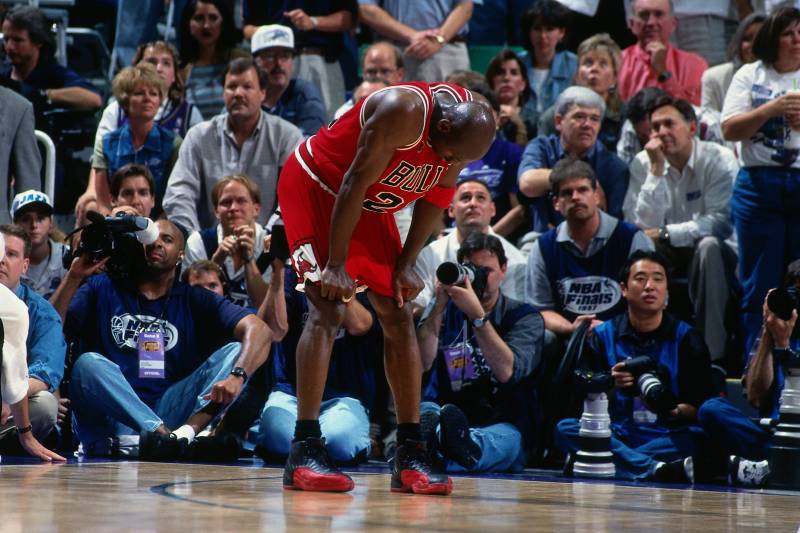
The night before game five in the 1997 NBA Finals against the Jazz, MJ recalls being in the Marriott hotel and being hungry late at night, which meant no available room service. Jordan’s friends would search around trying to find a pizza place that would deliver, Tim Grover, Michael’s personal trainer recalls that there was one place open, and five employees turned up to deliver the single pizza.
Jordan says that at 2:30 in the morning after eating the pizza, he was ‘throwing up left and right’. Due to this incident, Jordan instead says that the issues that were affecting him in that game was caused by food poisoning, not flu-like symptoms as was reported by the media prior to the game and has since been immortalised as ‘The Flu Game.
In that game, despite his visual fatigue, which teammate Bill Wennington describes as every timeout being as if the life were drained out of his body, Jordan would play 44 out of 48 minutes and score 38 points to lead the Bulls to victory.
#5. Shared tragedies
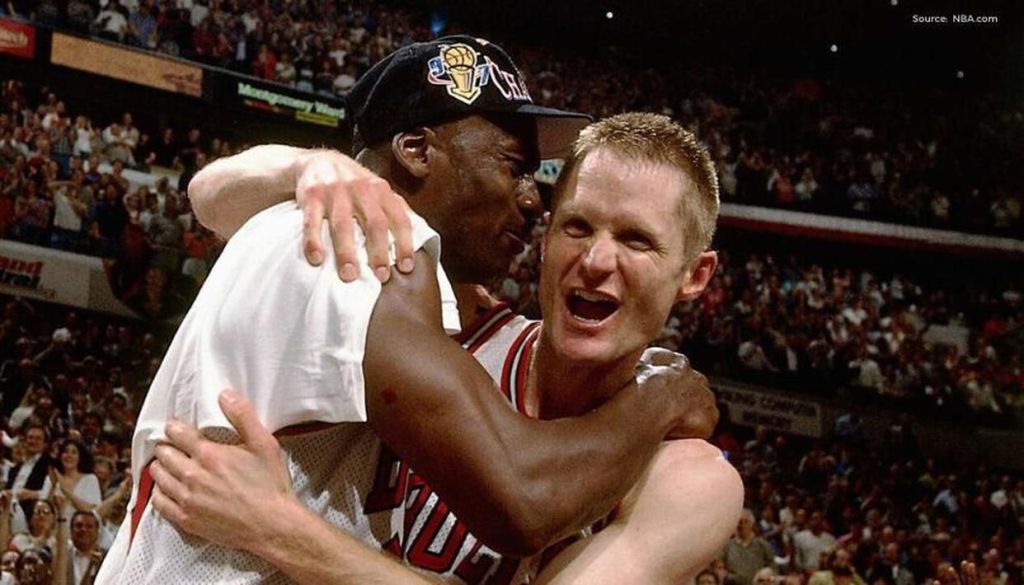
One of the most influential players in the Bulls’ success in their second three-peat was guard Steve Kerr, who to many took the role that John Paxson had held throughout the Bulls first three-peat.
Kerr describes how Paxson took him under his wing when he came to the Bulls in 1993 and taught him how to be valuable player alongside Jordan. When asked by the interviewer, Kerr discloses that him and Jordan never discussed their fathers, with Kerr saying that ‘I think it was probably too painful, for each of us’.
The context behind this is given as the documentary flashes back to focus on Kerr’s childhood, with his father being a professor of Middle East History and Politics at UCLA, a position that allowed Kerr to see some of the collegiate basketball games at the university which ‘stoked my fire for basketball’. Kerr describes how his father left UCLA to become the president of the American University of Beirut, the capital of Lebanon.
While Steve’s father Malcolm Kerr was in Beirut however, it was a hostile environment and Kerr was an American in a country which had drastically contrasting views. This hostility led to Kerr being shot and killed while on campus by two gunmen posing as students.
Following his father’s death, Steve Kerr recalls that he still went to practice the next day as he, ‘didn’t know what else to do.’ And how the tragedy pushed him deeper into basketball, admitting that he thought about it all the time while playing, even during the national anthem before the game, imagining how much his father would enjoy watching him play.
#6. Jordan’s protector
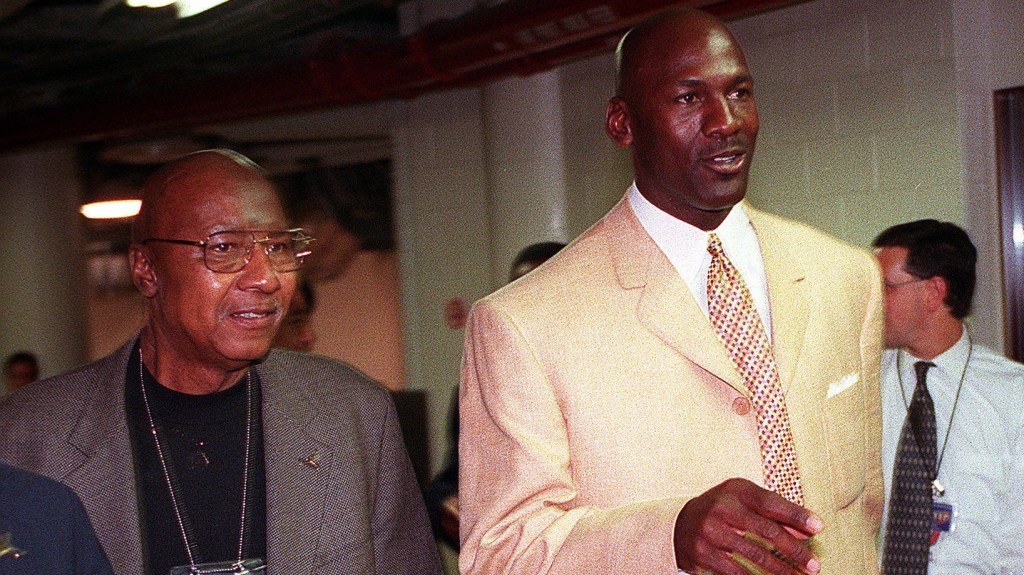
Prior to the game seven against Indiana in 1998, the documentary draws attention to Michael’s relationship with his security, in particular Gus Lett, Lett was a former Chicago police officer who began working at the Bulls’ home arena the United Centre, where he and Jordan would strike up a friendship as Lett was tasked with escorting Jordan from his car to his seat while Jordan was injured with a broken foot.
Tisher Lett, Gus’ wife also describes how he would support Jordan following his father’s death, MJ admitting that, ‘He became like a father figure to me’.
Gus would be diagnosed with lung cancer and take a leave of absence for treatment but would return before the aforementioned game seven against the Pacers. Jordan saying of the situation, ‘He was inspiration for me, I wanted to win this game for Gus’.
#7. Number six
The 1998 NBA Finals pitted the Bulls against the Jazz for the second year in a row, and the first two games were predictably tight, with Chicago and Utah each taking one win.
Game three would be a different story, however as the Bulls would annihilate the Jazz, beating them by 42 points and only allowing the Jazz to score 54 points, the lowest amount of points in a game put up by any team since the introduction of the shot clock. Chicago taking a 2-1 lead, winning by a score of 96-54.
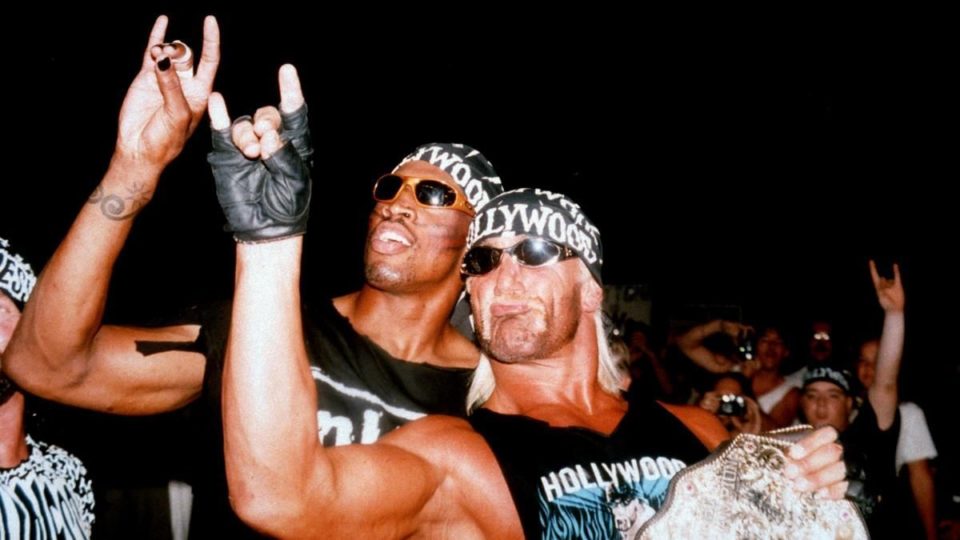
Following game three, the Bulls would be left with a problem as Dennis Rodman would no-show a scheduled team practice in favour of appearing on WCW Monday Nitro with Hulk Hogan as a member of the nWo. Rodman would be fined for the offence.
The Bulls and Jazz would again trade wins in games four and five, setting up a crucial game six in Utah, with the Bulls leading the series 3-2 and one win away from securing a second three-peat. In that game the Bulls would have a rough start, losing Scottie Pippen in the first quarter to a nagging back injury. With the Bulls down 49-45 at halftime, Pippen would return to the game at the beginning of the third quarter, beginning a sequence of Pippen playing a period of time, going back to the locker room for treatment and pain relief and then going back into the game to play again.
With 41 seconds left in the game, the Bulls would still trail by a score of 86-83.
#8. The Last Shot
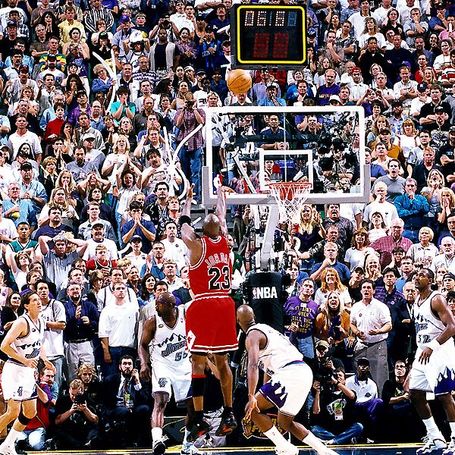
Michael Jordan’s career and reputation as one of the greatest players in NBA history would be defined over the course of those next 41 seconds, with Bob Costas calling it, ‘One of the greatest sequences you’ll ever see in any sport’.
Jordan would receive the ball coming off of a timeout and immediately drive towards the basket past Bryon Russell to execute a layup to bring Utah’s lead down to one point. The Jazz would come back down the court and put the ball down towards Karl Malone, with Malone backing up against Rodman, suddenly, Jordan would appear on Malone’s weak side and snatch the ball away from him to give possession back to Chicago with a chance to take the lead.
Jordan would drive towards the right, guarded by Russell again but suddenly cross the ball back to his other hand, sending Russell stumbling in the opposite direction, leaving Jordan wide open to nail a clutch jump shot to put the Bulls up by one with 5.2 seconds on the clock.
Those would be Jordan’s 44th and 45th points of the game and the Bulls would stop a Utah attempt to beat the buzzer and secure a game seven, winning the game 87-86 and the series 4-2.
#9. Changing the culture
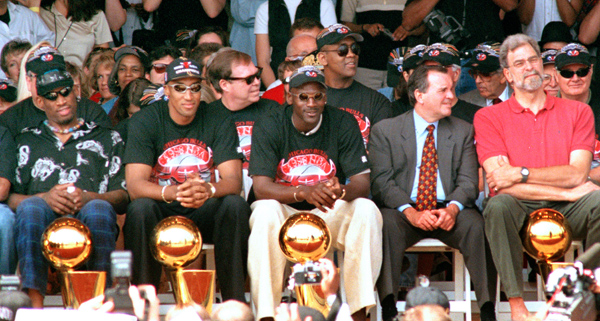
The Chicago Bulls dynasty of the 1990s took a franchise that would probably be considered a laughingstock prior to the selection of Michael Jordan in the 1984 NBA Draft and morphed it into one of the most recognisable sports franchises on the face of the planet. Late former-NBA Commissioner David Stern communicates the impact that the Bulls had on the league by saying that, ‘In ’92, the NBA was in 80 countries. And now the NBA is in 215 countries.’
Former President Barack Obama also emphasises the cultural impact that Jordan and the Bulls had on people’s perception of African American athletes and athletics in general by saying, ‘There are many great players who don’t have an impact beyond their sport. And then there are certain sports figures who become a larger cultural force. Michael Jordan helped to create a different way in which people thought about the African American athlete, a different way in which people saw athletics as part of the entertainment business. He became an extraordinary ambassador not just for basketball, but I think for the United States overseas, and part of American culture sweeping the globe. Michael Jordan and the Bulls changed the culture.’
#10. The Last Dance
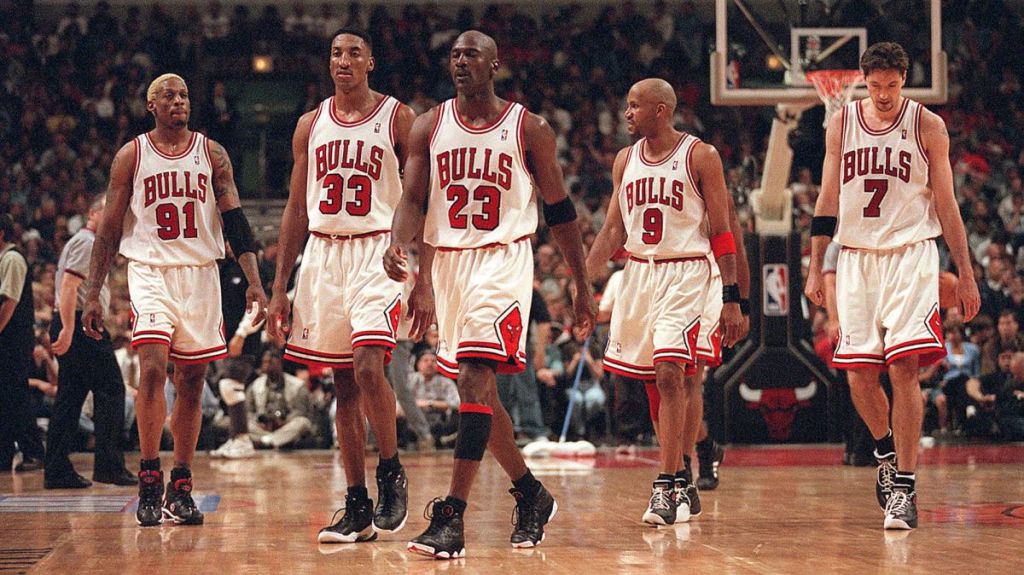
The documentary presents differing views on why the Bulls did not stay together to try to win a seventh championship, Bulls owner Jerry Reinsdorf claims that each player would have demanded too much money to make keeping the team together a viable option and cited that Phil Jackson did not accept his offer to return, as Jackson did not want to undermine Jerry Krause after the comments he made earlier in the season.
However, Michael Jordan argued that the team was already doomed after the comments made by Krause about Phil Jackson and a potential rebuild and said that if the Bulls had tried to offer everyone one-year contracts to come back just to try to go for the seventh, MJ believed that everyone would be convinced to sign.
Jordan went so far to describe it as ‘maddening’ to walk away at his peak as he felt that the Bulls could have won seven had they found a way to keep the team together, also saying that the fact that he wasn’t able to try is ‘something that I just can’t accept.’
At the final team meeting for the 1998 Chicago Bulls, Phil Jackson asked the players to bring in anything that they wanted to write about being a member of the team, bringing the players together to read the notes and then burn them. Steve Kerr remembers the meeting, saying that, ‘Every guy had emotional words to say. And I remember that Michael actually wrote a poem.’ Jackson expands on this by saying that the poem showed a ‘depth of emotion that you never thought he had.’
Kerr concludes by recalling how when the notes were read aloud, they were all put into a coffee can, before Jackson turned the lights out and lit the paper in the can, Kerr calling it, ‘one of the most powerful things I’ve ever seen.’
The documentary concludes with footage of a rookie Michael Jordan saying, ‘I just want the franchise and Chicago Bulls to be respected. Like the Lakers or the Philadelphia 76ers or the Boston Celtics. Hopefully, I can, and this team and this organisation can build a program like that.’
 The Inbound Observer